The current issue of ChildArt is now online. This issue is published in collaboration with the National Endowment for the Arts, the National Institutes of Health, and Johns Hopkins School of Medicine. You can find it at https://icaf.org/childart/ChildArt_ArtforHealth_July-Sept2020.pdf
Published by the International Child Art Foundation (ICAF), this group also produces the World Children’s Festival, which is postponed this year due to Covid-19. It will now take place on July 30th–August 1st, 2021 at The National Mall across from the U.S. Capitol.
As Ashfaq Ishaq, the Founder and Chair of ICAF, points out in the forward to this issue:
“While we rely on science to free us from Covid-19, art opens windows to new vistas and can serve as a mirror for self-improvement.”
 As I began Phillip Thurtle’s well-researched Biology in the Grid: Graphic Design and the Envisioning of Life, I wondered how his “envisioning of life” would intersect with the abundant evidence that a complex array of grids have served as a foundational element in art, architecture, and design production throughout history. A few examples that quickly come to mind include those used to construct perfectly proportioned Egyptian and Aztec temples, Islamic and Buddhist art, Chuck Close’s stylized portraits, and the layout of medieval illuminated manuscripts. Rosalind Krauss’ 1978 statement that the surfacing of the grid in early twentieth century modernist art was an announcement of “modern art’s will to silence, its hostility to literature, to narrative, to discourse” [1] is also a part of the grid litany, although one that gives a negative cast to how we use grids to engage with objects in our world.
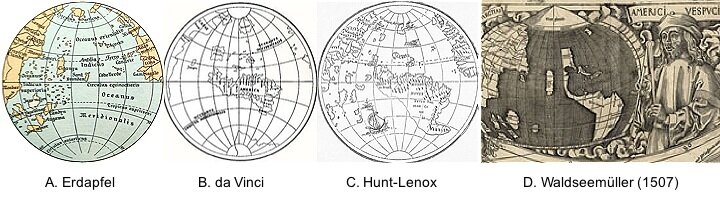 In addition to his better known artistic, scientific and engineering talents, Leonardo da Vinci has an extensive reputation as a cartographer, drawing maps for a wide range of hydro-engineering projects for the rulers of Florence, Milan, Arezzo and the Vatican, amongst others. However, he is not generally acknowledged as authoring a world map (or mappamundi) spanning the globe, which was the domain of a few specialized cartographers of the era. Nevertheless, there is a world map among his papers in the Royal Library, Windsor, which has the correct overall configuration of the continents, including an ocean at the north pole and a continent at the south pole. Moreover, it has a unique cartographic projection onto eight spherical-geometry triangles that provide close to isometric projection throughout the globe.